Reese bass
Wide beating movement with a clean sub held steady underneath.
Plugin / Free demo / £10 licence

Bass-forward phase-distortion synthesis.
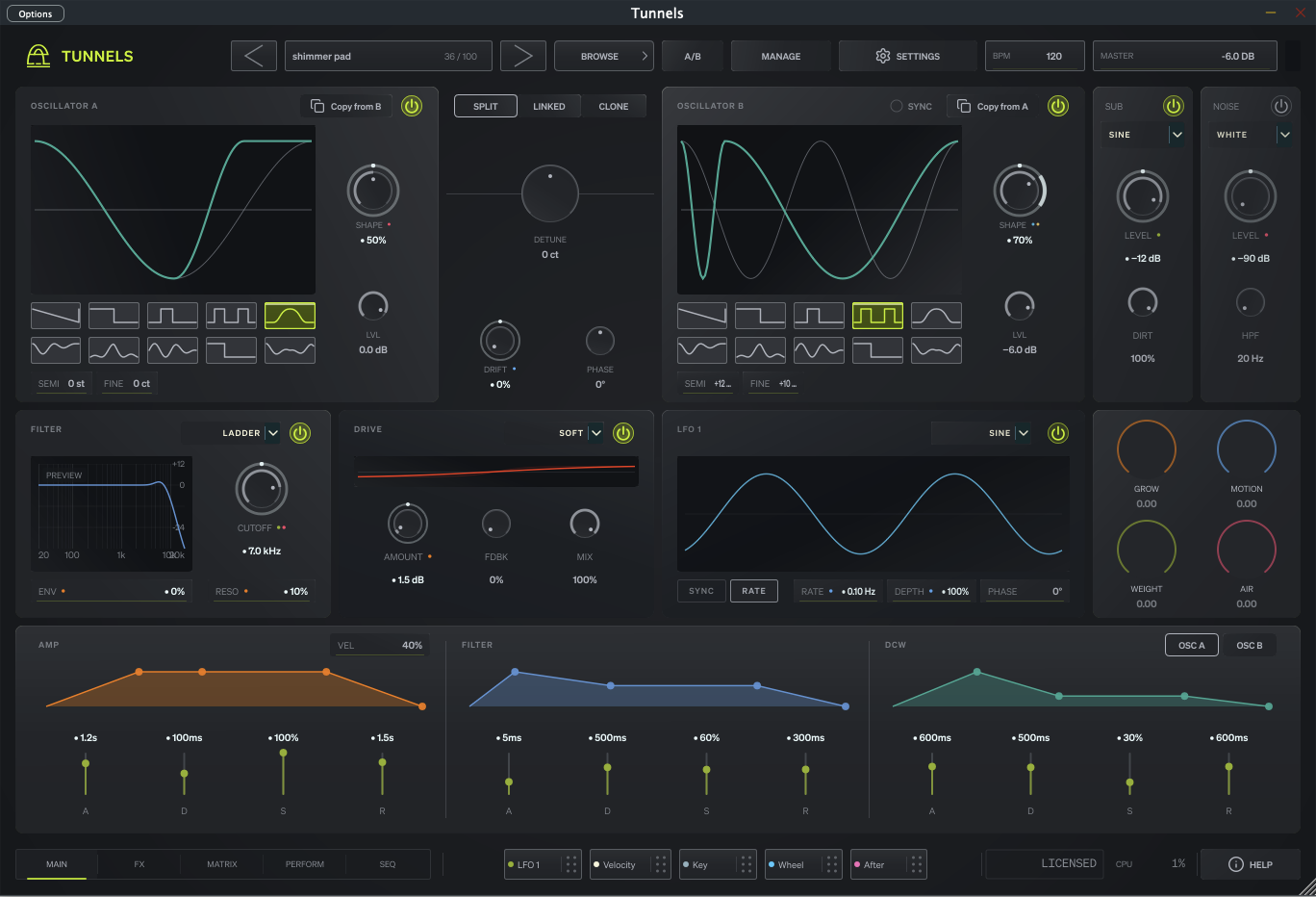
The hollow, vocal, aggressive timbres behind Reese, jungle, experimental bass, and wider synthetic tones, from a synthesis method most plugins don't have. Two phase-distortion oscillators, one DCW control that opens the tone from clean to snarling, then sub, noise, drive, filters, modulation, effects, arp, and step sequencing.
Free demo, every factory preset included. The demo periodically dips the audio output, so it is for evaluation rather than finished tracks. The £10 licence removes the dip and unlocks saving your own presets.
Hear it: Reese bass
Secure Paddle checkout. Instant licence delivery after payment.
Wide beating movement with a clean sub held steady underneath.
Vocal midrange pressure, folded drive, and filter movement for heavier lines.
A tearing pitch sweep for breaks, fills, and aggressive lead-bass moments.
Most synths subtract from a raw waveform, or scan through stored ones. Phase distortion does neither: it bends a sine wave's playback against itself, warping a clean tone into bright, resonant harmonics with a hollow core. It's the engine behind Casio's CZ synths from the 1980s, and the source of their distinctive metallic character.
One control, DCW, sweeps that warp in real time, from a pure glassy tone to a vocal, overtone-rich growl. It's a single playable gesture that does the work of several filters and envelopes elsewhere, which is why it's so expressive for evolving Reese movement and jungle bass.
Tunnels runs two of these oscillators with ten shapes each, so you can stack and detune warps for width, then shape the result with sub, drive, multiple filter models, and an eight-slot modulation matrix.
Hear it: one DCW sweep, three resonant shapes
Same gesture each time: one held note, DCW swept open from clean to full. Only the oscillator shape changes. No filter, no effects.
| Capability | Free demo | £10 licence |
|---|---|---|
| ~100 factory presets, 13 categories | Included | Included |
| Every synth parameter | Available for evaluation | Included |
| Audio output | Dips periodically | No demo dip |
| Save your own presets | Not available | Unlocked |
| Finished tracks and live use | Not suitable | Suitable |
AU, VST3, CLAP, Standalone. macOS, Windows, Linux. Mono or up to eight voices, with unison, glide, and mono legato behavior. Two phase-distortion oscillators feed sub, noise, drive, multiple filter models, modulation, effects, arp, and step sequencing.
Tunnels is a focused synthesizer, not a sampler or workstation. There is no wavetable import, sample playback, VST2, AAX, iOS, or iPad build. The engine is built around fixed phase-distortion wave shapes, sub, noise, filtering, drive, modulation, and performance tools.
Two phase-distortion oscillators with ten shapes. DCW is the main timbre and brightness control, opening the harmonic shape of each oscillator, especially on resonant waves. Detune in cents or fixed Hz, reset phase free/first-note/per-note, and use hard sync, PWM, or ring modulation for more aggressive movement.
Sine or PD, selectable from -2 to +2 octaves with semitone and fine tuning. Routes pre-drive or clean post-filter depending on whether the patch needs weight or control.
Stereo white, pink, or brown. Pre- and post-filter blend for tuck, air, and rougher jungle edges.
Soft tanh, asymmetric diode, or fold. Either side of the filter, inside the oversampled section.
Multiple filter models: ladder/Moog, diode/TB303, state/Steiner, plus phase/allpass filtering. The ladder model is a 24 dB ZDF design with tanh feedback and bass compensation.
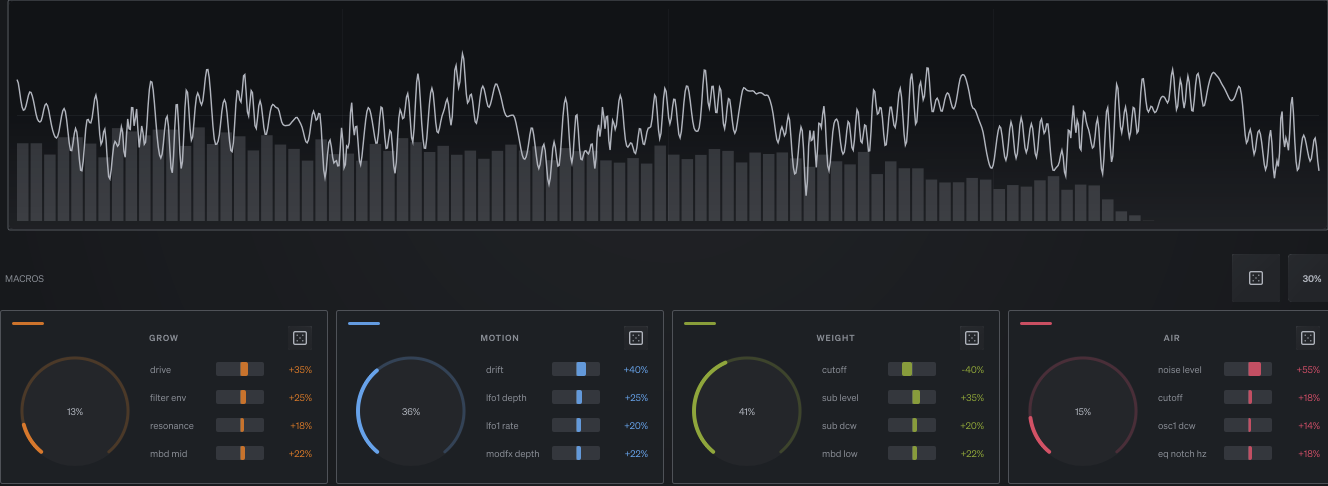
One LFO, four macros, and an eight-slot matrix, with eight target lanes per slot. Sources include velocity, key, mod wheel, aftertouch, DCW envelopes, filter and amp envelopes, random, beat phase, macros, and unison voice. Destinations reach the synth core and selected effects.
Mono, two, four, or eight voices, with one, two, four, or eight unison voices from the same voice pool. Mono mode keeps last-note priority and a held-note stack that resumes the previous note on release. Exponential glide; legato avoids retrigger and phase reset.
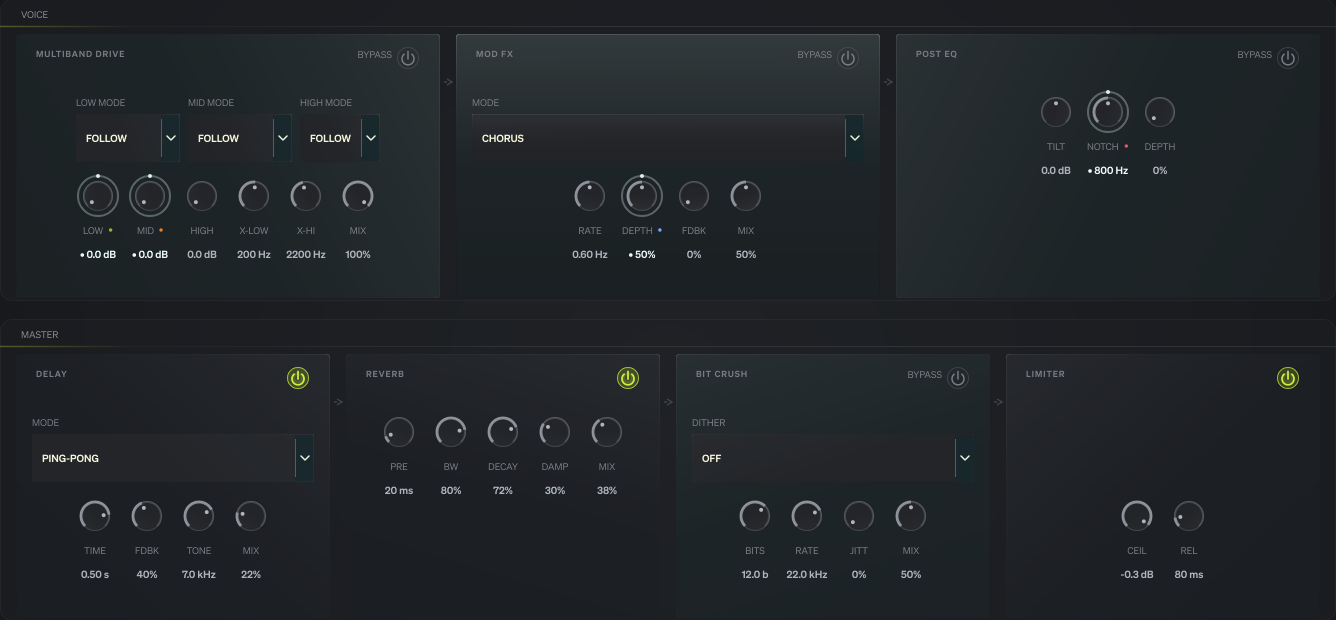
An onboard rack after the voice: multiband drive, modulation FX (chorus, flanger, phaser), post-EQ, delay, reverb, bit-crush, and limiter. Each stage switches in independently.
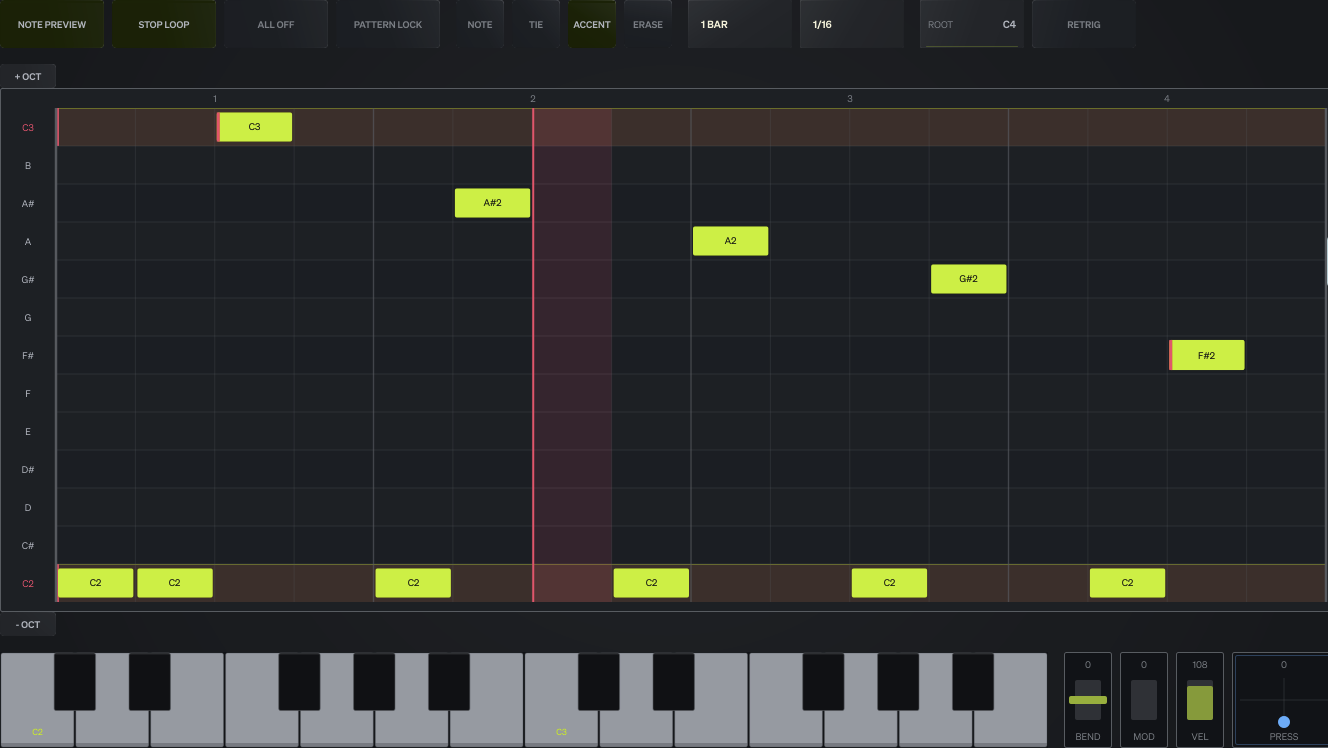
Built-in arpeggiator and step sequencer, both tempo-synced. Pitch bend is fixed at +/-2 semitones. Mod wheel and channel aftertouch route into the matrix.
Free demo: all ~100 presets across 13 categories included. The demo periodically dips the audio output, so it is for evaluation rather than finished tracks or live use. The £10 licence removes the dip and unlocks saving your own presets. One payment, no subscription, no online activation.
Version 0.16.0, published 4 June 2026.
Windows SmartScreen warning on the installer? Download the manual-install zip (10.3 MB) and copy the plug-ins into place — no installer, no SmartScreen.
The free demo is for evaluation: every parameter and all ~100 factory presets are available, but the output dips briefly on a cycle and you can't save your own presets. It is not suitable for finished tracks or live use. The £10 licence removes the dip and unlocks saving. Yours forever.
Use the £10 licence for finished tracks, live sets, and commercial releases. The free demo lets you test the sound and presets, but the periodic output dip makes it unsuitable for release or live use.
Engine updates are free while Tunnels is supported. Licensing is offline: no DRM phone-home, no online activation, no expiry.
A synthesis method that shapes tone by warping the playback phase of a sine wave, rather than filtering a raw waveform (subtractive) or scanning stored ones (wavetable). Casio's CZ series popularised it in the 1980s. The result: distinctive hollow, resonant, vocal timbres, and one main control, DCW, that opens them up as you play. Tunnels uses fixed PD wave shapes, not imported wavetables.
11 Big Sur or newer. Universal Intel and Apple Silicon build. Signed and notarized for public releases.
Windows 10 or newer, 64-bit. The installer is currently unsigned, so SmartScreen may warn on first run.
Debian / Ubuntu .deb package, plus a tar.gz with installer for other distributions. Restart the DAW after install.
AU, VST3, or CLAP hosts. Standalone is available with audio device selection and built-in MIDI input.
Installation, licence activation, preset loading, project recall, and plugin use do not require online access.
Tunnels is one developer. Bug reports go to GitHub. Replies usually inside a week. Buyers without GitHub accounts can email contact@beigethreat.com.
Lost your licence? Recover it with your checkout email and order ID or key.